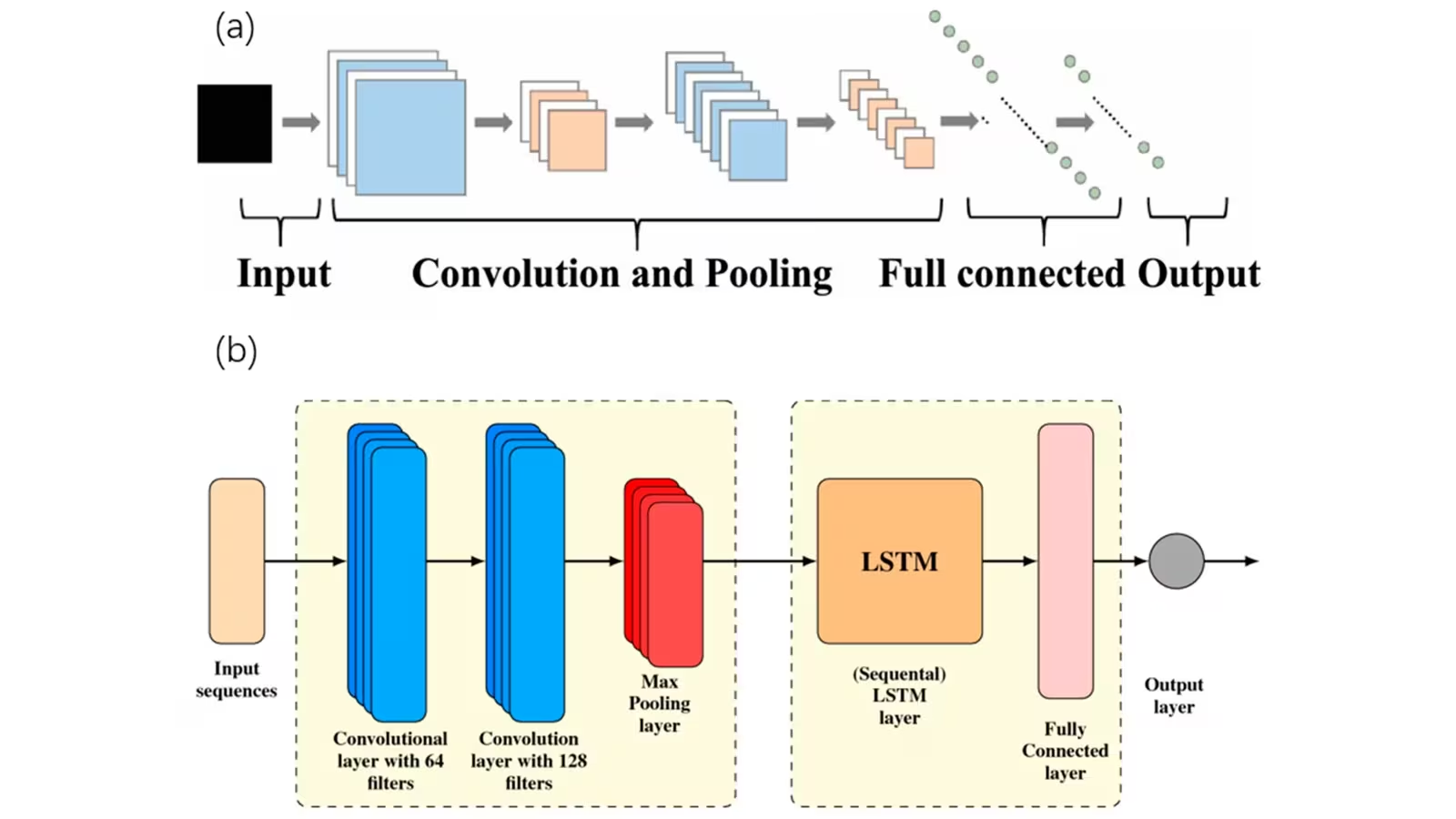
Food quality and safety inspection increasingly requires advanced solutions because conventional methods are challenged by the complexity of modern food systems. Effective inspection must address product quality, authenticity, and safety, together with process-related risks arising during production, storage, transportation, and distribution. However, existing analytical approaches and deep learning studies often focus on individual food attributes or sensing modalities, providing limited guidance for selecting appropriate models and sensing strategies for specific inspection objectives.
What the research examined
This review systematically compares CNNs, RNNs/LSTMs, Transformers, GNNs, GANs, and hybrid architectures, as well as transfer learning, self-supervised learning, contrastive learning, few-shot learning, lightweight networks, edge computing, and multimodal fusion. Beyond predictive performance, we evaluate dataset size and representativeness, sample- and batch-level validation, external validation, data-leakage risks, interpretability, computational requirements, and the maturity of food-specific evidence. The principal contribution is an application-oriented framework linking inspection objectives and food matrices with sensing modalities, model architectures, validation evidence, and deployment conditions.
What the findings mean
Although Transformer-, GNN-, GAN-, multimodal-, and few-shot-learning-based approaches show substantial potential, many remain at developing, emerging, or prototype stages in food-specific applications. For high-risk targets, including toxicants, allergens, adulterants, and foodborne pathogens, deep learning systems should primarily support rapid screening and decision-making, while safety-critical results require confirmation using validated reference methods. Overall, this review provides a systematic perspective on deep learning for food quality and safety inspection and identifies key priorities for future research and industrial deployment.
Study authors: Wang W, Jiang Z, Yang S, Qin Z, Shi Y, Zhu Y, Sun Z.. This report is based on the openly licensed abstract and source record and has been formatted for newsroom reading.
Foods (Basel, Switzerland)
https://europepmc.org/articles/PMC13606374This report is prepared from the public source listed above for news and industry-information purposes. Original research, text, trademarks and images remain with their authors and rights holders; open material is used under the licence identified by its source. Rights holders may contact rights@asiafoodtimes.com with evidence of ownership, and verified concerns will be corrected or removed promptly. This article is not investment, legal, medical or nutrition advice.